Dutching in Matched Betting
Dutching means backing every outcome at the bookies, with stakes set so you get the same return whoever wins. No exchange needed.

By RyanChecked 6 min readIntermediate
Dutching is a valuable strategy in matched betting that helps you stay profitable when lay betting isn't possible. Whether you’re trying to dodge tennis retirement rule mismatches or there’s no exchange market for an obscure bet, dutching gives you another way to qualify for free bets and extract value from bookmaker offers.
What Is Dutching?
Dutching means backing all outcomes, adjusting the stakes so that the total return is the same, regardless of who wins.
Dutching only involves back bets. We don't need to lay anything at an exchange.
When Should You Use Dutching?
- No matching lay market: Some promos are on niche markets (e.g., 'team to score first penalty') where exchanges don't offer matching markets. You can find odds at multiple bookies and use dutching instead.
- Rule mismatch: There might be differing rules between the bookie and the exchanges. The most common example is tennis retirement rules, which differ between sites and change from time to time, so check both before you bet. If the rules don’t align, dutching between two bookies that share the same policy avoids nasty surprises.
- Matched betting abroad: If Betfair or Smarkets isn’t available in your country, dutching lets you continue matched betting using only bookmakers.
- Gubbed accounts: Got accounts that don’t offer promos anymore? Use them to dutch selections and still make use of their odds.
How to Dutch a Bet
Let's imagine we want to qualify for this offer from Parimatch (an older offer, used as an example: always check what's live and the current terms):

We need to bet £10 on tennis at odds 2.0+.
We find an upcoming match between Novak Djokovic and Alexander Zverev:
Parimatch:
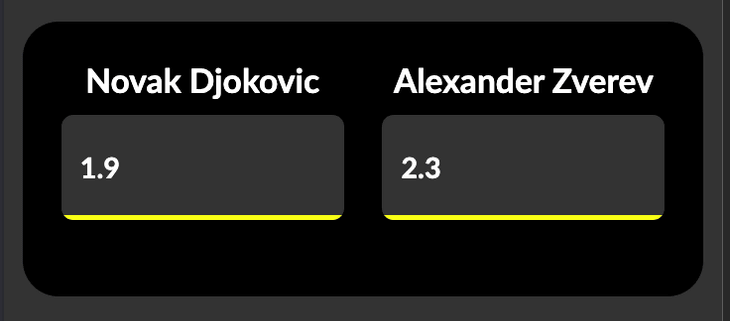
We need to bet £10 on tennis at odds 2.0+, so we could back Zverev at odds of 2.3 for £10.
Bet365:
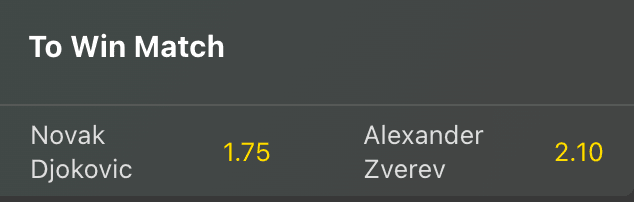
We need to cover all outcomes, so we find the same match on Bet365 and find the odds for Djokovic are 1.75.
Use the Dutching Calculator to work out your stakes. We want the stake for our first selection, Zverev, to be £10, so we enter odds of 2.3 for Zverev and 1.75 for Djokovic.
The calculator tells us to back Djokovic for £13.14.
- Place the first bet on Parimatch: place a £10 back bet on Zverev at odds of 2.3.
- Place the second bet on Bet365: place a £13.14 back bet on Djokovic at odds of 1.75.
- Your qualifying loss is 14p, and you have now qualified for the £40 in free bets.
| Outcome | First bet | Second bet | Profit/Loss |
|---|---|---|---|
| Zverev | +£13.00 | -£13.14 | –£0.14 |
| Djokovic | -£10.00 | +£9.86 | –£0.14 |
Using the Dutching Calculator
Our calculator lets you choose a First Selection Stake, or a Total Stake.
- First Selection Stake: You enter the exact amount you’ve already bet on one outcome. The calculator then works out how much to stake on the other selections so that your return is the same no matter which one wins.
- Total Stake: You decide the total you want to spend across all bets. The calculator splits that sum over each selection. This helps you control your outlay and stick to your budget.
Dutching isn’t just for events with two outcomes. You can back any number of selections — whether that’s football match odds, or ten runners in a horse race. The Dutching Calculator handles the maths for you, splitting your total stake (or fixing your desired profit) across every outcome. This way, you lock in the same return — or a small, controlled qualifying loss — no matter which selection wins.
Arbitrage Dutching
When the implied probability is under 100%, you’ve found an arb.
Before you start, calculate the implied probability of each outcome:
Implied probability = 100 ÷ decimal oddsWhen the sum of these probabilities is less than 100%, you’ve found an arb. Next, use a dutching calculator to split your stakes so you lock in profit, whatever the result.
Example
- Runner A @ 2.40 → 100 ÷ 2.40 = 41.67%
- Runner B @ 2.80 → 100 ÷ 2.80 = 35.71%
- Runner C @ 5.50 → 100 ÷ 5.50 = 18.18%
Total implied probability = 95.56% → Arb opportunity
Use the calculator to:
- Set your Total Stake across all bets.
- Or fix an Overall Profit target.
The tool will show you exactly how much to stake on each selection. Back those bets at different bookies to lock in your profit, as long as every bet stands.
Reserve arbing for accounts you don’t mind using heavily. Frequent arbing on main accounts can lead to gubbing. And if a bookie decides a price was an obvious error, it can void or resettle that bet, leaving the rest of your dutch exposed. See our arbing guide.
Final Thoughts
Dutching keeps your matched betting moving when laying isn’t an option. Use it for tricky promos, niche markets or overseas betting. Calculate carefully to unlock more value from every offer.