How to Read Odds For Matched Betting
Odds tell you how likely something is and how much you'll win. Here's how to read fractional, decimal and US odds, and switch between them.

By RyanChecked 5 min readBasics
Understanding how to read betting odds is essential for matched betting. In this guide, we’ll walk you through what odds mean, how to read different odds formats, and how to switch between them quickly.
What Are Betting Odds?
Betting odds represent the chance of an outcome happening, and how much you’ll win if your bet succeeds.
Bookmakers set odds based on how likely something is to happen, but they also include a built-in margin to stay profitable.
Bookmaker odds rarely reflect true probability
In matched betting, odds are key for finding profitable offers, locking in small, predictable returns, and calculating the right stakes.
What Types of Odds Formats Are There?
The three most common formats are:
- Fractional odds (e.g. 5/1)
- Decimal odds (e.g. 6.00)
- American odds (e.g. +500 or -200)
Let’s break each one down.
How to Read Fractional Odds
Fractional odds are traditional in the UK. They show how much you’ll win relative to your stake.
The number on the right is how much you put in (your stake).
The number on the left is how much you win (your profit). You also get your stake back.
Odds of 5/1 mean you’ll win £5 for every £1 you bet.
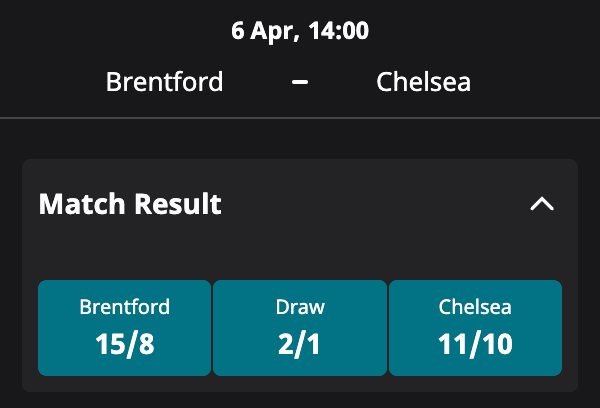
If you bet on...
- Brentford → Win £15 for every £8 staked
- Draw → Win £2 for every £1 staked
- Chelsea → Win £11 for every £10 staked
You get your stake back, too. If you bet £1 on a draw at 2/1, your total return would be £2 (winnings) + £1 (stake) = £3.
How to Read Decimal Odds
Decimal odds are the standard format on exchanges like Betfair. They’re easier to calculate with than fractional odds.
The number itself tells you your total return — winnings + stake.
So if the decimal is 2.00, you're getting back exactly double your stake. If it's 6.00, you get back 6x your stake.
Odds of 6.00 mean you’ll get £6 back for every £1 bet. That includes £5 profit + £1 stake.
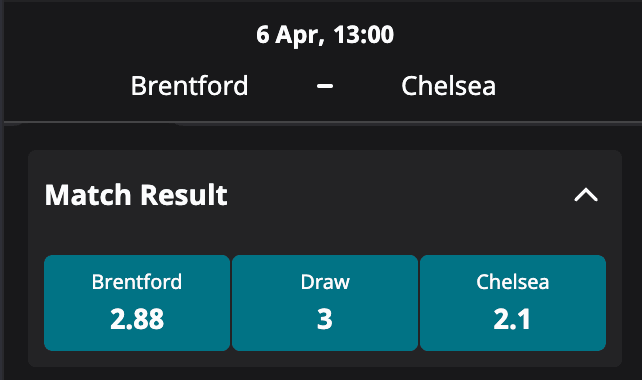
If you bet on...
- Brentford → £10 returns £28.75 including your stake
- Draw → £10 returns £30.00 including your stake
- Chelsea → £10 returns £21.00 including your stake
Decimal odds always include your stake. If you bet £1 at 4.00, your total return is £4 — that's £3 profit + £1 stake.
Matched bettors prefer decimals because they’re easier to compare, especially on exchanges and in calculators.
- Simpler maths
- Better for comparing prices between bookmakers and exchanges
- Used in all matched betting calculators
Fractional odds are often rounded to a simpler fraction, so they can hide small differences. In our Brentford example, 15/8 works out at 2.875, which shows as 2.88 in decimal. Always use the decimal price in calculators.
Most bookies use fractional odds by default. You can usually switch to decimal in the settings.
What are American Odds (Moneyline)?
You’ll rarely need American odds unless you're on a US-facing site, but it's good to recognise them.
- +200 → Win £200 from a £100 stake
- -200 → Bet £200 to win £100
If you need to convert them, our odds converter tool makes it easy. Here it is with Brentford's 15/8 from the example above:
What Is Implied Probability?
Implied probability gives you a rough idea of the chance of an outcome, based on the odds.
Remember, bookies build in a profit margin, so the actual probability will be a little less than the odds suggest.
For Decimal Odds:
Divide 1 by the decimal odds, then multiply by 100
Example: 4.00 → (1 ÷ 4) × 100 = 25%
For Fractional Odds:
Divide the number on the right by the sum of both numbers, then multiply by 100
Example: 5/1 → 1 ÷ (5+1) = 0.167 → 16.7%
Final Thoughts
Understanding odds is the foundation of matched betting. Whether it’s placing a qualifying bet, catching a price boost, or calculating a lay stake, odds are always involved.
Keep our odds converter handy — it’s the quickest way to compare formats, see value, and make smart betting decisions.